
Introduction
This blog originated from the vacuum that exists to address the concerns and needs of senior citizens living in independent living facilities (SILF) and other rental properties where they are allegedly deprived of even Canadian Bill of Rights!
Sadly, they have no recourse to seeking fairness and uprightness or having someone to address their legitimate questions and concerns. The main recourse is for them to go to the Landlord Tenant Board or to go to the provincial courts to seek justice. Apparently, there are no specific laws or statutes or Bill of Rights to protect their specific needs.
As you may be aware, senior citizens living in retirement homes and long-term care homes have protection under various statutes, including, but not limited to Retirement Homes Act, 2010, S.O. 2010, c. 11 (the “RHA”), Long-Term Care Homes Act, 2007, S.O. 2007, c. 8, as well as their respective “Bill of Rights”:
Residents’ Bill of Rights: Your rights if you live in a long‑term care home
Believe It or Not
Did you know that seniors living in independent living facilities (SILF) DO NOT HAVE ANY BILL OF RIGHTS including under the previous Canadian Bill of Rights? Check https://laws-lois.justice.gc.ca/eng/acts/c-12.3/FullText.html] . The Canadian Bill of Rights have been replaced with
CONSTITUTION ACT, 1982 – PART I Canadian Charter of Rights and Freedoms
| CONSTITUTION ACT, 1982 PART I Canadian Charter of Rights and Freedoms Whereas Canada is founded upon principles that recognize the supremacy of God and the rule of law: Guarantee of Rights and Freedoms Marginal note: Rights and freedoms in Canada 1 The Canadian Charter of Rights and Freedoms guarantees the rights and freedoms set out in it subject only to such reasonable limits prescribed by law as can be demonstrably justified in a free and democratic society. Fundamental Freedoms Marginal note: Fundamental freedoms 2 Everyone has the following fundamental freedoms: (a) freedom of conscience and religion; (b) freedom of thought, belief, opinion and expression, including freedom of the press and other media of communication; (c) freedom of peaceful assembly; and (d) freedom of association. |
Sadly, the above Charter Freedoms of many seniors living in SILF are denied and that is the focus of this blog.
It is important to note that due to ageism, seniors living on their own and in SILF have many needs like those of seniors living in retirement homes, but, they do not have sufficient protection from addressing their psychological, emotional, social, security, cultural needs, etc.
Most seniors living in SILF do not have the proper health, physical energy, resources, or mental agility to go to the Landlord Tenant Board to address the alleged transgressions by their landlords and due to this stress, their health deteriorates and that leads to increased health costs for ALL CANADIANS.
Hence the necessity for the Government to either introduce legislation like the Retirement Homes Act, or Long-Term Care Homes Act, 2007, S.O. 2007, or establish the SILF Residents’ Bill of Rights.
Ageism
Although old age is something that awaits everyone lucky enough to live a long life, for many the actual experience of aging in Ontario is typified by a sense of loneliness and isolation.
85% of Canadians want to age in place. And yet only 2% of seniors receiving home care can get by without a patchwork of support from friends, family, or neighbors. Against this backdrop of ‘precarious support’, many seniors are seeking out new models of care to help them live independently.
According to WHO https://www.who.int/westernpacific/news/q-a-detail/ageing-ageism:
Ageism is the stereotyping and discrimination against individuals or groups on the basis of their age. Ageism can take many forms, including prejudicial attitudes, discriminatory practices, or institutional policies and practices that perpetuate stereotypical beliefs.
What is the impact of ageism on health?
Ageism has harmful effects on the health of older adults. Research by Levy et al. shows that older adults with negative attitudes about ageing may live 7.5 years less than those with positive attitudes.
Ageism has been shown to cause cardiovascular stress, lowered levels of self-efficacy and decreased productivity.
Negative attitudes are also widely present even within the health and social care settings where older adults are at their most vulnerable.
Some of this prejudice arises from observable biological declines and may be distorted by awareness of disorders such as dementia, which may be mistakenly thought to reflect normal ageing.
Socially ingrained ageism can become self-fulfilling by promoting in older people stereotypes of social isolation, physical and cognitive decline, lack of physical activity and economic burden.
During the webinar on December 2, 2020, on “Convention on the Rights of Older Persons”, Dr. Kiran Rabheru mentioned that during the then COVID-19 pandemic the following facts have come to the forefront:
- We have statistics on seniors who have died in long-term care and other institutions
- We have statistics on the number of seniors affected by COVID-19
But unfortunately:
- We do not have statistics on the number of seniors suffering from the ill-effects of Ageism.
Sadly, those seniors who live on their own and those seniors living in independent living facilities only come under limited statutes which is not sufficient to look after the security needs (see section on needs below). It is important to note that seniors living on their own have many needs like those seniors living in retirement homes as described below, but, they do not have sufficient protection from addressing their psychological, emotional, social, security, cultural needs, etc.
This blog is intended to find a solution for seniors living in SILF and other rental properties that will enrich their lives with information that addresses social justice, seniors’ rights and environmental issues and comply with the existing laws and lobby for new laws to protect them. We believe that “Information is Knowledge and Knowledge is Power “. We believe that lack of information causes fear and fear among senior citizens is the root cause of stress and ill health.
If possible, we could endeavor to reduce the stress and pressures on the management of seniors independent living facilities by empowering ourselves to brainstorm on solutions that improves our lives. Foremost, would be to allow seniors to form their own Seniors Tenant Association independent of the management! Thereafter, we can have our own Newsletter to share information with all senior residents particularly for those who do not have access to the Internet. As seniors, we will design, compile, print and distribute this Newsletter without depending on the management for any funds. This would be in strict compliance with the Residential Tenancies Act and the Charter of Rights and Freedom.
We will be embarking on a campaign to survey the concerns, wishes and goals of senior living independently and those in SILF to have a just, peaceful, and harmonious living conditions wherever they may live. As a member of the organization, they are encouraged to submit their concerns, and questions and we will endeavor to answer them to the best of our ability. If we do not have an answer, we will refer them to the resource that would be able to help them. In other words, we will function as Seniors helping Seniors.
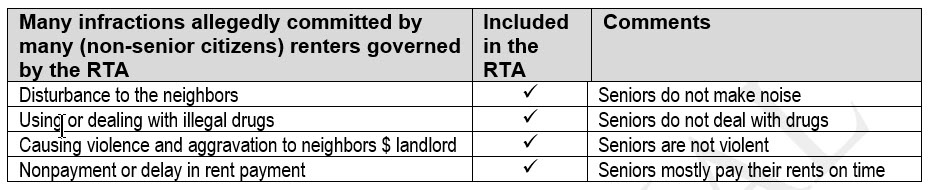
For the reasons explained in the next section*, it is disingenuous to club together all tenants – senior citizens and non-senior citizens – under the protection of the same Residential Tenancies Act, 2006, S.O. 2006, c. 17 for the reasons given below and covered in the next section*.
Senior citizens living in rental apartments:
- Mostly do not make noise or have loud parties
- Are not inclined to deal with drugs or other illegal substances
- Are not violent
- Mostly pay their rents on time
Therefore, they need their own Bill of Rights and protected by a separate statute – since their needs and rights are quite different from the other tenants and they should have their rights protected like those seniors living in retirement homes and long-term care homes – where they are protected under the Retirement Homes Act, 2010, S.O. 2010, c. 11 – and have their own Resident’s Bill of Rights.
Needs of Seniors Living in Independent Living Facilities (SILF) – the absence of which indirectly leads to Increased Health Costs
As you know, Maslow’s hierarchy of needs is a motivational theory in psychology comprising a five-tier model of human needs, often depicted as hierarchical levels within a pyramid. Needs lower down in the hierarchy must be satisfied before individuals can attend to needs higher up. From the bottom of the hierarchy upwards, the needs are physiological, safety, love and belonging, esteem, and self-actualization.
This blog is intended to find out whether in addition to the physiological and physical needs of the residents who are all senior citizens, should the following needs* also must be met:
What is bullying?
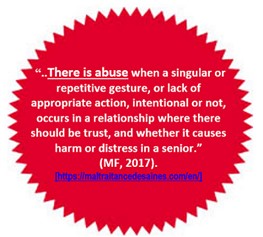
Bullying is sometimes called harassment and happens when someone hurts, intimidates, or scares a peer consciously or unconsciously. When someone is being bullied, they often have a hard time defending themselves. Bullying is usually not a one-time event. It can happen repeatedly.
People of all ages can be bullied. The Centre for Elder Research is working with Sheridan faculty member Dr. Kirsten Madsen and Elder Abuse Prevention (ON) to better understand bullying between older adults age 55+ in Ontario. This work is funded by the Social Sciences and Humanities Research Council of Canada and aims to support the development of best practices and strategies for this diverse population. Unfortunately, the research did not address the bullying of elders 55+ that is perpetrated by people in authority – including landlords of SILF! And that is one of the reasons for this document!
This SILF Model highlights the need of senior citizens who are encouraged by the Governments on one hand to live on their own, but on the other hand, the Ontario government is not protecting the rights of seniors who want to live on their own in rental properties. Some seniors living in SILF are subjected to covert Elder Abuse – both by peers and landlords of SILFs – which is being ignored by various organizations who erroneously believe that seniors living in SILF are protected by the Residential Tenancies Act. Or they are only concentrating on Retirement Homes and Long-term Care Homes.
Seniors living in SILF are looking to enrich their lives with information that addresses social justice, seniors’ rights and environmental issues and comply with the Residential Tenancies Act and the Constitution of their own SILF. We believe that “Information is Knowledge and Knowledge is Power “. We believe that lack of information causes fear and fear among senior citizens is the root cause of stress and ill health.
We are devoting this blog to highlighting the plight of residents of seniors independent living facilities (SILF) who are mostly seniors over the age of 65 (and included in this blog is a solution to assist other senior citizens living on their own). Many of them vary in ages from 60 to 100+. Some seniors reside in a non profit seniors only residence. They are indeed provided with basic facilities of mostly clean safe, and quiet environment. Of course, things could be better, and this document is expected to gather and share information that could make SILF more sustainable.
The Model suggested in this blog could endeavor to reduce the stress and pressures on the management of seniors independent living facilities by empowering the residents of SILF to brainstorm on solutions that improve their own lives. For example, they could have a legitimate independent Tenants Association – which is covered in the Residential Tenancies Act – but is allegedly not allowed by many landlords/managements of SILF. Further, the seniors could have their own Newsletter to share information with all senior residents particularly for those who do not have access to the Internet. As seniors, they could design, compile, print and distribute this Newsletter without depending on the management for any funds. Currently, some landlords develop their Newsletters devoid of any input from the seniors nor paying attention to any suggestions from the seniors. They seek to enforce their own views some of which are prejudicial to the interests of the seniors.
Depending on the approval of this Model and the funding we can receive, we intend to embark on a campaign to survey the concerns, wishes and goals of seniors living in SILF to have a just, peaceful, and harmonious living conditions wherever they may live. As a member of the organization, they are encouraged to submit to us their concerns*, and questions and we will endeavor to answer them to the best of our ability. If we do not have an answer, we will refer them to the resource that would be able to help them. In other words, we will function as Seniors helping Seniors.
Counseling and Conflict Resolution Services
For the first time in the history of elder abuse, peer abuse, landlord toxicity, family feud, prevention of stress and mental anguish, etc. we can offer seniors unique services which include:
- Counselling and giving an opportunity for seniors to voice their grievances
- Conflict Resolution after following the required protocol
Details of these services can be worked out after discussions with organizations like ACE, NICE, CanAge, AgeWell, etc.
Critical Information
Facts that have been overlooked, or ignored by politicians, bureaucrats, lawyers, and Public Health that is causing the alleged rise in cost of health care for seniors who reside in independent living facilities

So, what is the Solution?
Now the cat is out of the bag, and the facts are clearly outlined (if you accept the facts and the evidence to support the facts), they have been brought to the attention of the following established organizations. These organizations are registered as being advocates for elders in Ontario and therefore supposed to address the needs of ALL seniors and include in their operations to do their due diligence and come up with a practical solution. Their mandates do NOT specifically exclude seniors living in independent living facilities. And yet specifically seniors living in SILF are excluded from their services or research. Here are some examples:
Organizations designed to address the needs of ALL senior citizens
Sadly, none of the above organizations have responded to our request to comment on the alleged disparity in the Residential Tenancies Act, and our suggestion to deal with this disparity with our alternative solution of Seniors Helping Seniors by:
- Working towards developing the Bill of Rights for seniors living in SILF; and
- Developing a Seniors Advocacy & Resolution Group to follow up on (1) above and providing sustenance to address the needs of all seniors as described in the following sections.
Through this carefully researched and crafted blog, we are requesting the following:
- Serious efforts should be made by all organizations, NGO’s, seniors’ groups, etc. to highlight the vacuum that currently exists in the lives of seniors living in SILF and other rental properties – indirectly increasing the health costs of all Canadians.
- Establishing the Bill of Rights for Seniors Living in Rental Properties and on their own.
- Creating a separate NGO called Seniors Advocacy & Resolution Group – to undertake the work that would improve the lives of most seniors living on their own. This would be in line with the vision of all governments to encourage seniors to live in their own places of residence and reduce the pressures on long-term care homes.
- We urge the reader of this blog to kindly spare your resources to carry out your own due diligence and research and publish through your available mediums the disparity existing in the Residential Tenancies Act, 2006, S.O. 2006, c. 17, that could be adversely affecting the health and lives of elders and thus increasing the health costs in Canada.
How can we make a difference?
Many seniors have endured injustice, unfair practices, violation of our rights, etc. and they have given up on expressing their discontent at services like physiotherapy, vision, dental, etc. being taken away.
But the time of action is now. We can and should not give up and do something that has not been tried before by seniors’ groups.
You will see from the example that once we register Seniors Advocacy & Resolution Group as a Non-profit organization, the doors will open to get grants and funding from various organizations – including the Law Foundation of Ontario – provided we endeavor to meet their requirements:
It is therefore important that we stop procrastinating and take the first steps towards achieving our common goal which is to fight for the rights of seniors that have fallen withing the cracks and need to be brought to the forefront.
Counseling and Conflict Resolution Services

For the first time in the history of elder abuse, peer abuse, landlord toxicity, family feud, prevention of stress and mental anguish, etc. we can offer seniors unique services which include:
- Counselling and giving an opportunity for seniors to voice their grievances
- Conflict Resolution after following the required protocol

Details of these services can be worked out after discussions with organizations like ACE, NICE, CanAge, AgeWell, etc.
We will be providing unique services that are not being offered by other landlords and non-profit organizations. These include:
- Environmentally friendly services
- Services for those seniors suffering from visible and invisible disabilities
- Lobbying services to promote the interests of seniors suffering from disabilities in SILF
- Consultation services to other SILF who do not have the knowledge or manpower to introduce certain services
- Obtain special deals from large corporations
- Free eyeglasses and walkers to those most vulnerable seniors
We must emphasize that the purpose of our SHS project is to:
- Register SENIORS ADVOCACY & RESOLUTION GROUP as a non-profit NGO in order to enter into any discussions or apply for any grants in order to fulfill our Mission Statement.
- Secondly, we can use SARG as the legitimate entity to develop a SHS Model in order to get grants/funding and be a resource to seniors living independently and those in SILFs in Canada and globally!!
- Address the existing vacuum that was described in the Introduction to this blog by mobilizing all the stakeholders. This includes lobbying the government to introduce legislation that would protect the rights of seniors since they have many needs (described earlier) that are similar to seniors living in retirement homes – but those needs are ignored by landlords and other officials.
- We will be focusing on preventive measures to help senior citizens to be aware of their rights, obligations, and benefits of collaborating with this project. In this connection, we will be conducting surveys and workshops on various topics, including but not limited to:
(i) How to deal with a toxic landlord;
(ii) How to deal with bullying;
(iii) How to express yourself when you have a grievance and the landlord does not pay attention.
(iv) How to prepare for an emergency
(v) Whom to call when you have problems in your homes or residences. - Foster social activities like interactive groups to participate in games that rewards with prizes which will enable members to be motivated with incentives.
- Participate in the forthcoming Federal government Environmental programs. This would include joining with the EcoAction of the government by promoting use of biodegradable items.
- We will undergo training on the Accessibility for Ontarians with Disabilities Act (AODA) and provide services to our members and other seniors who need special attention due to various visible and invisible disabilities.
- Organize trips to the zoo, casinos, museums, and sites that seniors love to visit.
- Enlighten members on current technology like zoom, virtual meetings, etc.so that they can interact with their families and friends during any emergency or pandemic.
- Obtain approval from companies like Bell, Rogers, Telus to provide wholesale discounts to members and set up a local volunteer support centre in the building.
- Arrange computer classes to encourage members who are willing to learn new skills like Word, Email, etc. to expand their communication skills and keep their minds agile.
- Encourage members to want to know information that would assist them to live meaningful lives, fire prevention, fire drills, fall prevention, what happens when their TV fails or what to do when they have problems accessing services like Bell, Rogers, etc.
- Provide information on how to prevent or avoid Elder Abuse and how to recognize Elder Abuse and how to deal with that situation.
- Provide the members with opportunities to express themselves with their concerns about safety, security, sharing of information, etc. without any retributions as some members may feel.
- Encourage members to volunteer with new ideas that could help all senior citizens.
- Provide information on Estate Planning.
- Provide critical information to seniors about addressing their fears and qualms about fire occurrences. One idea is to have a trained volunteer “Fire Marshall” on each floor to keep the seniors calm if and when there is a real fire. This will get us “brownie points” when applying for funding.
- Take up the causes of seniors (residents, members, etc.) who have issues which are not being addressed adequately and fairly, including lobbying with the Government on issues that matter most for safety and security of senior citizens – specially during the current COVID-19 pandemic.
- Offer our services to senior citizens who have no other recourse, for example seniors living in Senior Independent Living Facilities and share our Model with them.
- Offer seniors ADR and Conflict Resolution services.
- Undertake campaign to offer seniors free/discount eyeglasses, dental services, walkers, etc.
P.S. Many of the above services will help us to get funding sooner than later!!
Skeptics may say that “you cannot do any good without money”
If that is the concern, we are delighted to bring to the attention of the reader that there are several methods to raise funds and apply for government funding that would serve two** main purposes:
- Improve the health and well-being of senior citizens
- Serve the Community
This blog provides an insight into how someone could play a role to achieve both the above two objectives**.
Let no one dare say that we cannot do good for the senior residents and the community at large because we have no money or no provision in the budget. The key is to have a genuine will to do good and as the saying goes “where there is a will, there is a runway” …. and where there is no will, there are only excuses.
Here are some links for you to see for yourself the Federal and Ontario Governments funding for seniors’ programs. A more comprehensive list will be discussed after receiving feedback about this document:
We hope you believe that there are several options for seniors to get funding and grants provided the applications are articulated accordingly. Some of us have those skills.
The key to success for registration as Charitable status and to get funding is in the documentation. Those who have experience in preparing documentation for funding or for any government approvals, will be invited to share their writing skills.
We believe that senior citizens themselves have an understanding of what they want and they are undergoing and therefore they can make a list of things that they would like to see happen for the benefit of senior citizens.
Some of the requirements to get funding are as follows:
There must be a commitment from the leaders of the group that they want to do some good for the benefit of the senior citizens. Remember the acronym ROB (Rights, Obligations and Benefits)
- The group/organization must be a registered non-profit entity.
- The leaders of the group must have a clear vision of what they want to do to achieve charitable status
For example, one of the conditions for receiving Charitable Status is to avoid being broad and vague in our purpose.
What is meant by broad and vague purposes?
Broad and vague purposes may be unclear in their scope or in their intent.
Broad purposes are often expansive and do not always express a direct or tangible charitable benefit. They can permit both charitable and non-charitable activities. Examples of broad objects are: “To foster an appreciation of the English language”; “To end homelessness”; and “To fight poverty.”
Vague purposes are ambiguous and can be interpreted in many ways. They leave us guessing about the true intentions of the organization. Examples of vague objects are: “To help the deserving”; “To encourage participation in the community”; and “To foster support of the challenged.”
Believe it or not!
Did you know that the Government of Canada is spending more on refugees than they are spending on senior citizens?
Believe It Or Not!
To start with the project, the basic understanding is as follows:
- There must be a clear and definable Mission Statement strictly benefiting most senior citizens including those living in SILF and addressing their psychological, emotional, cultural and security needs (e.g. fear of being evicted if they voice their grievances – which is predominant with seniors living in rental accommodation where there may experience covert elder abuse or even violations of the Accessibility for Ontarians with Disabilities Act (AODA).
Following is a draft of the Mission Statement:
The Seniors Advocacy & Resolution Group (SARG) will promote the wellbeing of seniors – including those living in SILF to live an active life without any constraints from the landlords and others who inhibit senior citizens from living their lives to the fullest thus reducing their stress levels and indirectly saving on rising Health Costs.
- The window of funding is not always open depending on the budget season.
- The group must additionally either register with the respective department of the Government that gives the funding or keep a lookout for an announcement inviting applications for funding.
- When the window is opened and applications are invited, the group has to prepare a convincing proposal with facts and figures that will convince the approving authority that we mean what we say, and we say what we mean. There must be no ambiguity in what we want to achieve which will benefit senior citizens.
- Those interested in the project should document their own personal and community needs that require funding.
- The list prepared above would then be tabulated and see which needs are urgent or important or feasible.
- Based on those members of the group who are dedicated and ready and willing to work on the project, a list of key members of the team will be drawn up and their commitment will be documented. Each member of the team will contribute an agreed amount to use to cover up the initial costs, i.e. lawyer’s fees, accountant fees, etc. and a start up fund under the control of the founding members. This amount will be accounted for when the funding comes from the government and sponsors.
- Consult with a lawyer to find out our Rights, Obligations and Benefits (ROB) of this project.
- Prepare the Articles of Association to be used for the registration.
- Consult with an Accountant who would do the necessary registration as a non-profit registered Group with charitable status.
- Talk to the landlord to explain to them ROB and our initiative to keep them informed.
- Based on the above, we get registered with the Federal govt. and get a licence from CRA for charitable status.
- Once the registration is completed then we contact the various government agencies and register with them to be informed when the window gets opened for funding or for grants. At this time some windows may be closed, but they would be open in due course and we have to be ready for that.
- We then work on those projects that we need to tackle that would strictly benefit seniors who have been excluded before. We then draw up a project plan to show how our project meets with the funding requirement.
- We create a website and a newsletter to keep those interested in the project informed of the objectives and plans of the project.
- We seek sponsors to build up a reserve to carry out soliciting and philanthropy activities.
- We cooperate with CARP and other seniors’ groups and share our knowledge and experiences with them.
- We petition the landlord for a rent free apartment for use of our project and in return we will offer our services FREE of cost to the landlord and to the Residents Association and share with them the benefits that our project will receive.
After reading this blog in its entirety, you are requested to send an email to:
SeniorsHelpingSeniorCitizens@gmail.com
with responses to the following questions if you want to be involved with the project and receive updates of the project as we are awaiting information from organizations listed on this blog.
Things to do after reading this blog
| Which part of this blog you felt you could relate to? | |
| Which sections of the blog you felt did not meet with your satisfaction? | |
| Which part of the blog you felt you could participate and make a difference? | |
| Do you feel this blog resonates with the need for more to be done for seniors living in independent living facilities? | |
| Do you believe this blog has addressed the needs of most senior citizens? Or do you feel more needs to be done? If so, what would you suggest? | |
| What is your list of items you would like to see happen for the benefit of seniors in independent living facilities and in other environments which is currently missing? | |
| Are you willing to stand up and contribute part of the $ required to register SARG as a Non-Profit Corporation under the NFP Act and thus be a Director of the Board? | |
| Your Comments please | |
| Your Name and Contact Information to receive updates: For more information, please send an email to: SeniorsHelpingSeniorCitizens@gmail.com |
Send email to: SeniorsHelpingSeniorCitizens@gmail.com or call (647) 930-8466
 Freedom to share information to the right audience
Leave a reply to Is bullying (and elder abuse) in seniors rental apartments, alleged silent killers ignored by the government and NGO’s? – Freedom to share information to the right audience Cancel reply