
At a senior’s residence, between 2022-2023 there was turmoil in the tenants’ association two executive elections. Upon inquiry it was learnt that the landlord decided to defunct the tenants’ association. At first, it was confusing as to why would a tenants’ association of 100% members be made obsolete due to the alleged transgressions of around 4% of the members? I was even wondering whether that was covered in the law (RTA).
In response, I would like to take a neutral position and look at the facts.
- The first question that comes to my mind is whether in a seniors’ residence can there actually be power imbalance and can that be resolved amicably?
To get to the truth, let us begin with a prayer for discernment:
“…Let the light of knowledge and truth shine down upon us so that we may know the difference between the truth and falsehood; right and wrong; just and unjust; good and bad. May the truth set us free from the chains of deception, ruse, ignorance, hypocrisy, bullying, stunts, and ploys that prevent us from complying with God’s plan, the laws of the land and enjoying life to the fullest.” – Anonymous.
For example, the chart below will explain the power imbalance between groups and possibly how to address them:
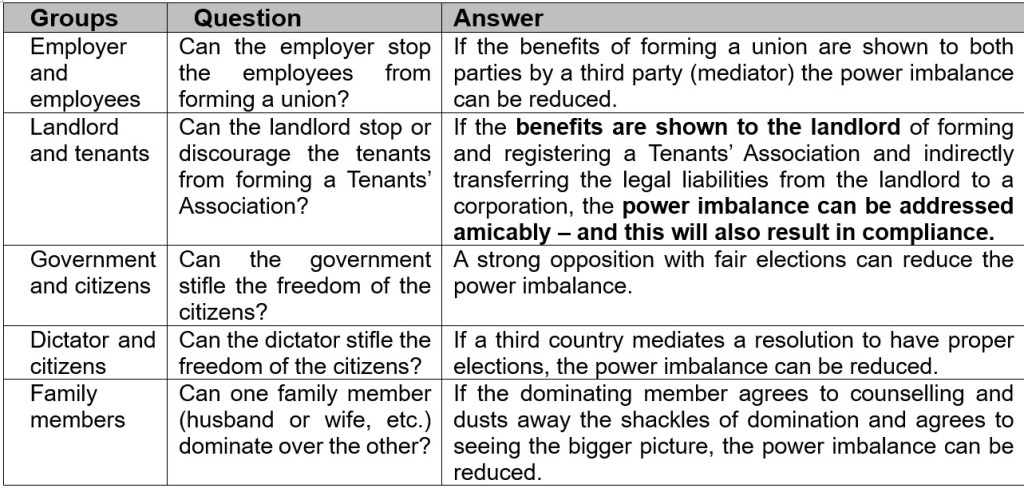
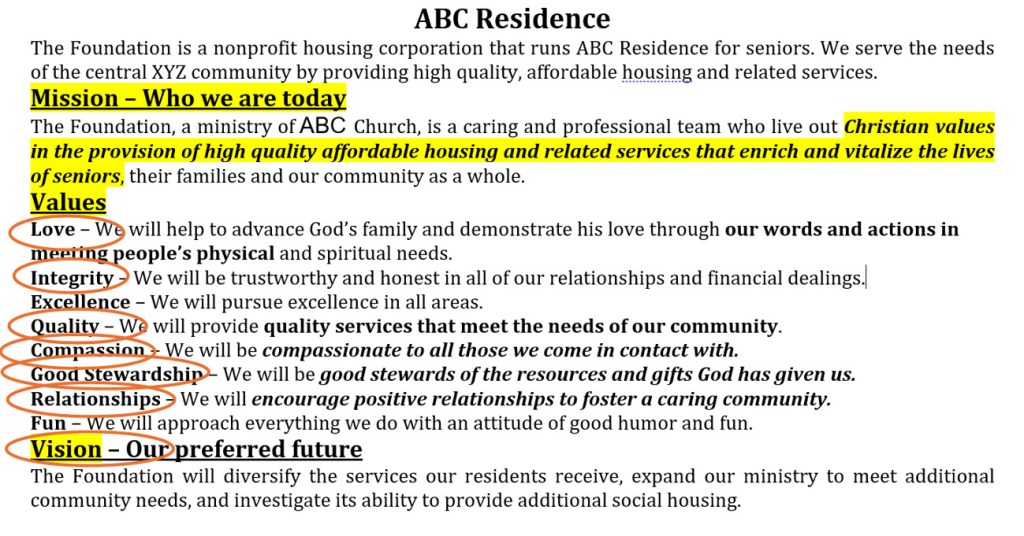
P.S. The Foundation has provided the tenants, who are senior citizens, with clean, quiet, and safe living conditions at an affordable monthly rent. Some rents are subsidized (and thus the government is involved), but the landlord is made whole and gets the full market rents. There are, however, many other issues that matter to the residents who are senior citizens. They need love, caring, sharing, good stewardship, excellence, empathy, compassion, justice, integrity, honesty, transparency, and of course fun, etc. (which are indeed included in the Foundation’s Mission Statement) and which play a role in the balance of power. If at all, there are financial constraints to meeting the physiological and psychological needs of the residents, the seniors have a solution – but the power imbalance needs to be removed.
In this specific case, since the Foundation is a ministry of a church, and has explicitly defined its mission statement as below, obviously the landlord can strive to reduce or even to remove the power imbalance. Correct? Let’s see below:
On in-depth analysis it was found that the key problem lies with the elections at the Tenants’ Association Executive even under the watchful eyes of the landlord. Some of those transgressions are as follows:

By addressing the above transgressions and removing them (as part of the Mission Statement), the Foundation will earn the goodwill of the tenants. This would also ensure a fair and just election and thus remove all the maladies, problems and disruptions that is making the landlord discourage forming a Tenants’ Association. The problem is not with the tenant’s association or even with the tenants.
The Problem:
The problem is the presence of power imbalance and the fact that the landlord is not allegedly willing to introduce the same procedures for tenant’s meetings and the same election model as the church and have the church monitor the elections from beginning to end – even though the landlord is a ministry of that church. Once the meetings and elections are conducted in a fair and just manner without any alleged bullying and election fraud, the tenants’ association can function amicably without any animosity provided the constitution and byelaws are crafted professionally (preferably with the input from a legal expert) and enforced through the bylaws when the association is registered.
Now lets look at the law:
Primary Purpose of Residential Tenancies Act, 2006 (https://www.ontario.ca/laws/statute/06r17 )
The purposes of this Act are to provide protection for residential tenants from unlawful rent increases and unlawful evictions, to establish a framework for the regulation of residential rents, to balance the rights and responsibilities of residential landlords and tenants and to provide for the adjudication of disputes and for other processes to informally resolve disputes. 2006, c. 17, s. 1. It is our legal right to have a tenants’ association. That is the law! Under Ontario’s Residential Tenancies Act, Section 23: A landlord shall not harass, obstruct, coerce, threaten or interfere with a tenant.
Following are some of the differences between a Social Group and a Tenants’ Association:
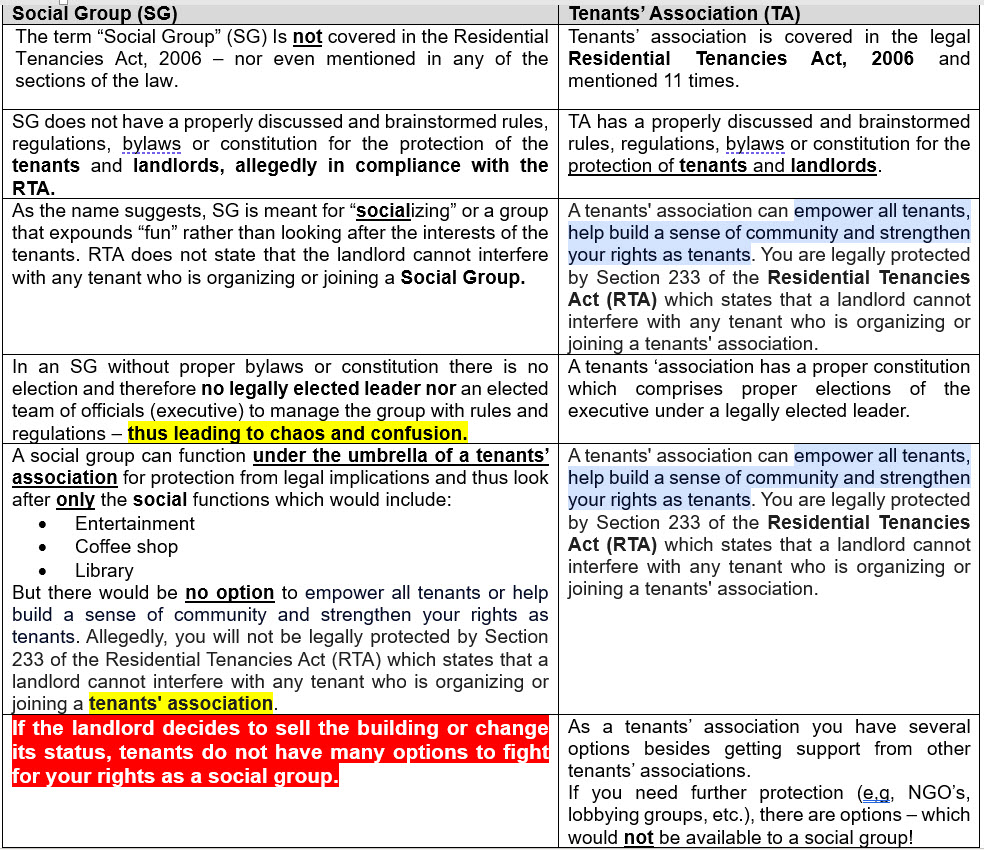
Any organization, group, association, clique, band, party, union of more than three or four, etc. would need to have an agreed set of rules or constitution to make it viable. Can a social group look after the needs and wants of 300+ tenants? Without having a detailed constitution or rules of the SG, it appears that a Social Group will only address the last value of “fun” promised by the Landlord. The question is, what about the other seven values which the Foundation promises to offer?
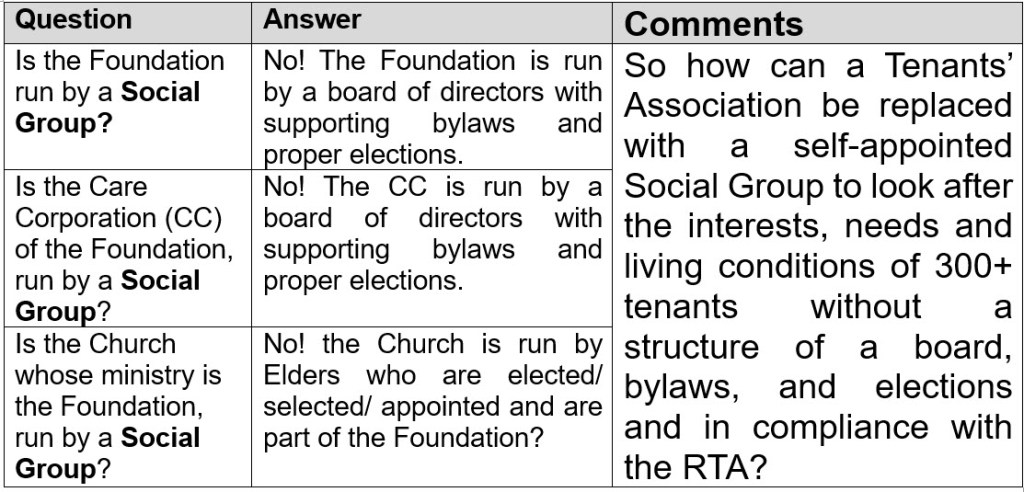
Final food (questions) for thought:
For further information on the position of a social group in a residential building, please go to this link:
https://chat.openai.com/share/020d953b-9ef4-48c0-988e-6408ffc2bb55
 Freedom to share information to the right audience
Leave a comment